
Surface complexation at the molecular scale
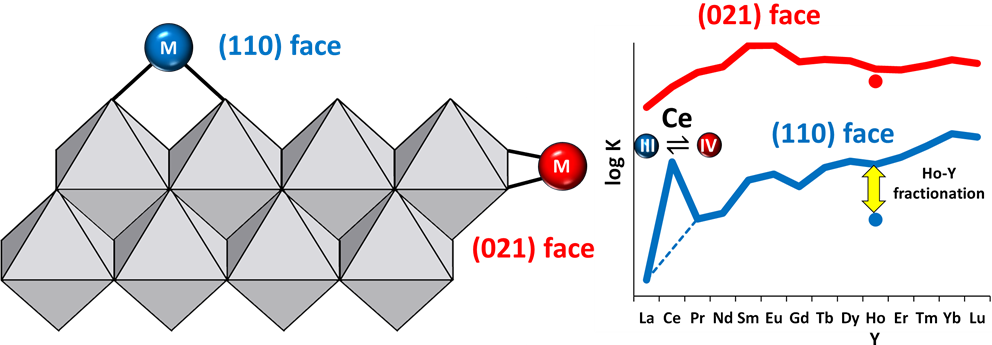
Facet-dependent adsorption at the surface of goethite
Iron oxyhydroxides are common minerals found in soils, sediments, and water. They play an important role in how pollutants behave in the environment — including how contaminants attach to surfaces, how available they are to living organisms, and how they move through water and soil.
These minerals are not all the same. Their surfaces have different shapes and structures, and this affects how strongly pollutants stick to them. Some surface areas bind metals very tightly, while others bind them more weakly. This means that where a contaminant attaches on the mineral surface can strongly influence how stable or mobile it becomes.
To understand these surface-specific interactions, scientists need detailed information about the shape, structure, and reactivity of the mineral particles. This usually requires advanced laboratory techniques combined with measurements in water. However, this is difficult because natural particles are very small, highly variable in size, and have many different surface features.
Because of these challenges, new methods are needed to better measure and describe how different surface sites behave in water. Improving this understanding will help scientists build more accurate models to predict how contaminants move, react, and persist in the environment.
reactive transport modeling at the column-scale
Reactive transport in quartz porous media
Rare earth elements (REEs) are increasingly recognised as emerging environmental contaminants, but we still do not fully understand what controls how they move through soils and water. This is because REEs behave as a group of many similar elements that can interact with environmental surfaces in complex ways, sometimes helping or competing with each other.
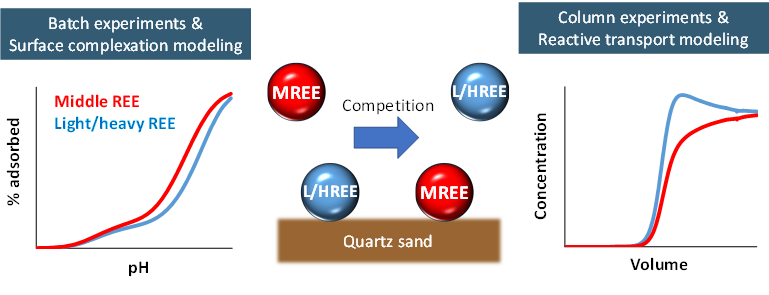
In this study, laboratory experiments were carried out to understand how REEs interact with quartz sand, a common material in natural soils and aquifers. Both short-term batch experiments and flow-through column experiments were used to simulate real environmental conditions. In addition to REEs, several related elements (such as scandium, yttrium, thorium, and uranium) were also examined.
The results showed that different groups of REEs attach to quartz surfaces in different ways. Medium and heavy REEs were found to bind more strongly, especially at both low and high concentrations, indicating the presence of two distinct types of surface binding sites. Based on these observations, a mathematical surface model was developed that successfully predicted how REEs and related elements attach to quartz.
The experiments and transport modelling also demonstrated that the strongest surface sites play a key role in controlling REE movement, and that different REEs can compete with each other for these sites. Overall, this work provides important insights for improving models that predict how rare earth elements move and react in natural environments.