
Advanced Imaging Techniques
4D X-ray microtomography of particle transport and retention in porous media
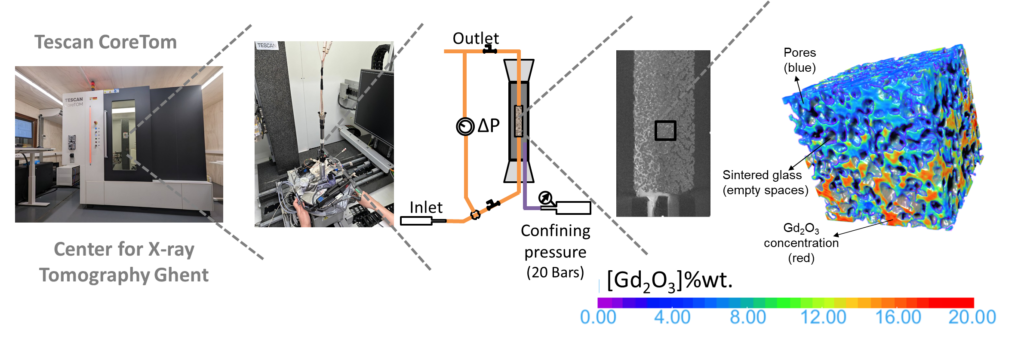
Colloids, which range in size from nanometres to micrometres, can deposit within pore spaces, clogging flow pathways and significantly altering permeability. While the porosity reduction and clogging effects caused by micron-sized particles have been studied extensively, the dynamic effects of nanoparticles on permeability reduction and flow redistribution in three-dimensional porous media remain largely unresolved. To address this gap, I conduct time-resolved 3D X-ray micro computed tomography (micro-CT) to visualize nanoparticle (NP) transport, retention, and clogging processes in situ. Our innovative experiments can effectively track how nanoscale colloid deposition modifies hydrodynamic conditions within complex pore networks, thereby uncovering mechanisms that have often been overlooked in traditional 2D microfluidics or bulk column studies. These groundbreaking experiments delivered the first direct visualization of nanoparticle transport and clogging phenomena in 3D porous media over time, revealing how deposition initiates and propagates throughout intricate pore networks while altering local hydrodynamics. This process drives significant permeability reduction along with notable flow redistribution patterns. The findings have strong implications for developing improved predictive models for colloid transport dynamics as well as groundwater remediation strategies, contaminant migration assessments, and subsurface energy storage applications.
metal organic assemblages on contaminant transport
Effect of iron-organic matter colloids
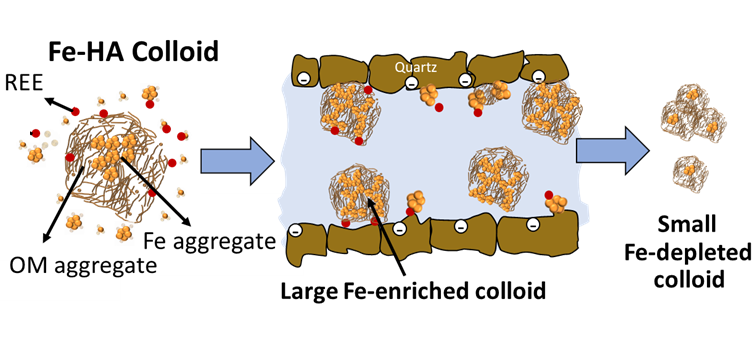
Colloids significantly influence the transport of potentially harmful elements like rare earth elements (REE) due to their high adsorption capacity and mobility. Their heterogeneity in size and composition makes them responsive to changing biogeochemical conditions, yet their transformation during transport is underexplored. By combining batch and column experiments, we investigated how colloid heterogeneity affects REE mobility using quartz sand as the immobile phase and iron–humic acids (Fe-HA) nanoaggregates as the mobile colloidal fraction. Differences in breakthrough curves for Fe and organic matter indicated elemental fractionation, particularly at lower Fe-HA concentrations where shifts in colloid composition occurred with increased contaminant loading. Dynamic Light Scattering (DLS) revealed two main colloid populations (~100 nm and ~500 nm), with smaller particles eluting earlier while larger aggregates showed higher Fe enrichment. Unique REE patterns were used to explore surface speciation, competitive binding dynamics, and deviations from equilibrium during transport processes. This study provides insights into colloid-facilitated migration of REEs in water-saturated porous media, emphasizing implications for contaminant mobility across various soils and sediments.